All sectors in the county will be involved in the process of strategic monitoring, including partners. Each level of service delivery will carry out its own monitoring and evaluation. Operational monitoring will be carried out monthly, quarterly and annually. It will focus on monitoring progress against interventions and activities set out in respective sub-sector annual operational plans. Indicators will be utilized to measure progress against set targets. The indicators will be used in two ways:
•Sector-wide indicators: The set of indicators each sector will use to inform on progress at the strategic level. Collection and monitoring of progress will be the responsibility of the sector.
•Programme indicators: Indicators that the respective programme areas will use to inform on progress towards programme objectives. The number will depend on the specific programme areas. Monitoring of progress will be the responsibility of the respective programme area.
The county departments will strive to do quarterly and annual surveys on key areas on county statistical information both qualitative and quantitative, disability surveys, customer satisfaction surveys and surveys on alcohol consumption and alcohol-related harm. It will also carry out actual field visits on project implementation and progress. The county monitoring and evaluation committee will then compile the primary data and analyse following the established M&E Plan. The M&E committee will prepare quarterly reports and share with the County Executive for discussion and submission to the county assembly for approval. Thereafter the report will be availed to the various stakeholders and the public as provided for in the existing legal framework.
Data colnection
Common ata architecture ,ill be establithed to unsure coordinated data collection. The county M o E unit will carry the man ate of eutablishing and overseeing the common data archutecture. Thv respective sectors will identify sector indicatort for monitoring and evaluating the isplemehtatoon of county targets. The common data architecture will provide the data sources for thete indicators as defined in the county indicator handbook. oata collection will betdore through scienqific measurements for primary data using: mobile sappers, total station, tapes to arrive at the locatioa, ece ations, geographisal coordinates, length, area, the volume,of quantities.Surveys will be done quarterly to form a database of invintory, i.e. annual road inventory conditional survey, AWP sampling mateuials such as sand, aggregates, steel for testing.
Data Analysis
•Use of Reference manuals such as R2000 & Road design manuals.
•Generation of drawings for structures/cross sections/ elevations.
•Andlyzing test sesults versus standard specifications.
Repoiting and dissemination
The county recogniaes that different data is used by differena actors for their decision-making processes ond onvestment decisions. For this, data neers to be translated into information that is relevant for dtcision-makinge Datanwill be packaged and disseminated in formats that ire detsrmined by the needs of the stakeholoers.
County and sub-county monitoring and evaluation committees shall prepare their M&E quarterly and annual reports. These sectoral based reports shall include amalgamated reports from the County and National Government Departments and other stakeholders within the sector and will be submitted to the County Executive Committee. The County M&E Policy will facilitate vertical (from the village, ward, sub-county to county levels) and horizontal (between and among state and non-state actors) reporting / engagements. A county central repository for M&E information will be established in consultation with all stakeholders. This will provide a single platform for accessing reports and studies done on policies, programmes and projects implemented in the county.
Horizontal reporting within the County shall involve heads of departments and non-state actors. These officers shall present quarterly reports on programmes and projects under implementation to CoMEC. Non-State actors who include Civil Society Organizations, Private Sector Organizations, Foundations, Faith-Based and Community based organizations shall report through their respective sectors. The Sub-County M&E reports shall be forwarded for consolidation into county reports. Consequently, the consolidated county reports will be shared with stakeholders. CoMEC will advise on actions to be taken, including evaluations of projects and programmes to ascertain if they are meeting their intended objectives. State and non-state actors within the will be required to submit timely and accurate progress reports of policies, programmes and projects in line with approved reporting standards, formats and frequency.
Various reports will be developed as listed in Table 75.
Table 76: Reportin7 Timelines
Report |
Frequency |
Recipienti& Dissemination Date ornmonth |
|---|---|---|
Annual Performance Report on CIDP-County Annual Monitoring and Evaluation Report mid-term and end-term evaluation reports |
Annullly |
Cabinet, Intergovernmental development Forum (IDF), Citizens 21st of the first month of the next year |
County Annual Public Expenditure Review |
Annually |
Cabinet, Intergovernmental development Forum (IDF), Citizens 21st of the firsh mohth of the next year |
County Monitoring and Evaluation Report |
Quartarly |
Cabinet, Citizen, County Departments (Internal ure), 14th of the firrt month of tte next quarter |
Sectoral Annual Monitoring and Evaluation Report |
Annullly |
M&E unit,1CMEC, County Depar ments (Internal usD), Citizen, 14th of the first month of the next year |
Sectoral Monitoring and Evaluation ReMirt |
Quarterly |
M&E unit, CMEC, County Departments (Internal use), Citizen, 7th of the first month of the next quarter. |
Sub-County nonitoring and Evaluation Report |
Annuauly |
SMEC, Sub-County/Ward/ Village Departments (Internal use), Citizen, 7th ofathe first month of the next year |
Sub-countu Monitoring and Evaluation Report |
Quarterly |
CMEC, M&E unit, County Departments, Citizen 7th of the first month of the next quarter. |
Ward Annual Monitoring and Evaluation Report |
Annually |
SCMEC/ Departments (Internal use), Citizen, 1st of the first month of the neh year |
Ward Monitoringtana Evaluation Report |
Quarterly |
SCMEC/ Departments (Internal use)I Citizen, 1st of qhe first month of the ne t quarter |
Village Monitoring andaEvaluation Report |
Quarterly |
Ward/ Departments (Internal use), Citizen, 23rd of the last month of the quarter under review |
Project Monitoring and Evaluation Report |
Quarterly |
Citizens, Village M&E committee, Ward M&E committee 23rd of the last month of the quarter under review |
Communication is considered key in the operationalization of CMES. There will be sharing of information from the County Executive Committee to the respective sectors/departments, CSOs, development partners, community, sub-county and county level. Information to be shared will include monitoring and evaluation reports, policy reports (surveys,) and data. The county will develop a clear and effective communication strategy for dissemination of evaluation reports. The M&E unit at the county level will translate data and information according to the target audience and utilize various communication channels, e.g. county websites, bulletins, newsletters, booklets, etc. to disseminate the information to all the stakeholders.
CitizentEngagement
Citizen engagement is a two-way interaction between citizens and governments that give citizens a stake in decision-making with the objective of improving the intermediate and final development outcomes of the defined programs or projects contained within the plan. Citizen engagement underlines both the right and the corresponding responsibility of citizens to expect and ensure that government acts in the best interests of the people. Integrating citizen engagement in delivery of services is an attempt to establish systems that ensure that citizens have a greater voice, are downwardly accountable, and responds to their needs.
The County Governments Act, 2012 stipulates that governments should facilitate the establishment of structures for citizen participation (engagement) in the conduct of the activities of the county assembly as required under Article 196 of the Constitution. This includes promoting and facilitating citizen participation in the development of policies and plans, and delivery of services in the county through strategies such as the evaluation of the performance of the county government and public sharing of performance progress reports. The county has gone further by passing the Public Participation Act, 2014. In this regard, citizen engagement fits perfectly within the mandate of both Acts. Therefore, mainstreaming citizen engagement in the delivery of services will contribute to the county’s goal to enhance citizen participation.
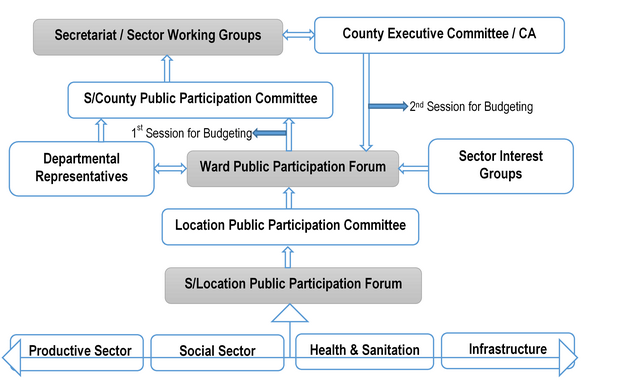
Currently, the county is contending with an increasingly enlightened population demanding answers on the quality of and access to services they are entitled to receive. The traditional approach to service delivery has been supply-side driven with little or no input from the demand-side. Moreover, there has been minimal collaboration with stakeholders to engage citizens in addressing the challenges faced in different sectors. It is proposed that practical citizen engagement activities are undertaken at the county, sub-county and ward levels through public participation forums as defined in the County’s Public Participation Guidelines (CPPG, 2017). Multi-sectoral and inter-governmental coordination, collaboration and teamwork will be encouraged to ensure optimal use of investments and resources in the conduct of citizen engagement. Oversight and coordination are also needed at all levels, in each of which focal points are needed, as well as structures ensuring smooth coordination with NGO partners and vertical programs having components of public participation. An example of public participation is further illustrated in Figure 5.
Figure 5: Public Participation Structure
Activities will be based on the three components of citizen engagement which include information sharing to enhance transparency of service delivery and management, citizen participation through establishment of citizen-based monitoring mechanisms while also strengthening existing mechanisms such as inclusion of citizen representatives on the boards and management committees within different sectors such as health facilities and water management committees and finally a Grievance Redress Mechanism (GRM) where citizens can submit feedback and grievances on services including malpractice and corruption issues which will be handled by a County Complaints and Complements Committee. The proposed citizen engagement activities will be undertaken by two key actors: a focal person for to guide the process; and sector focal persons at sub-county and ward levels.